Stinging insect pressure across Grand Rapids spikes sharply between June and October as single queens establish multi-thousand-worker colonies. In historic areas like Heritage Hill and Eastown, architectural features…
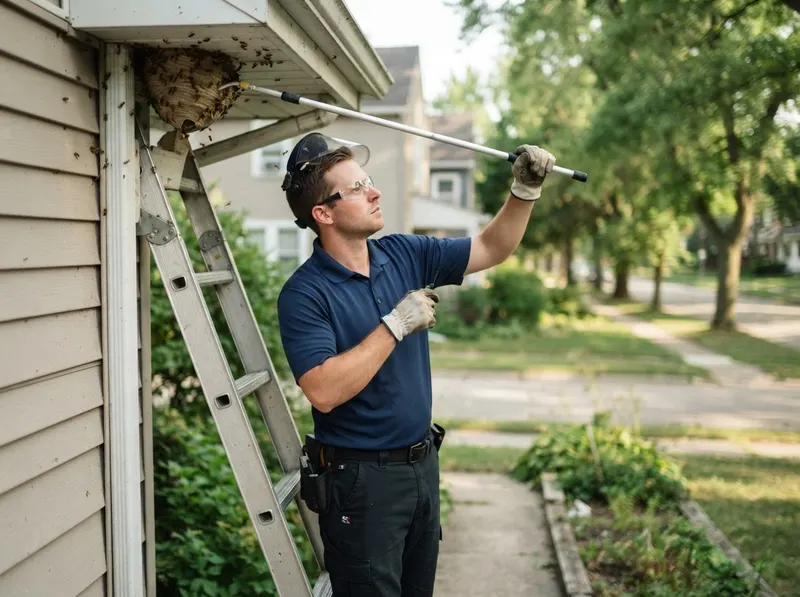
Stinging insect pressure across Grand Rapids spikes sharply between June and October as single queens establish multi-thousand-worker colonies. In historic areas like Heritage Hill and Eastown, architectural features such as exposed soffits, wrap-around porch pediments, and deep crown moulding offer sheltered nesting sites for Polistes paper wasps and aerial hornets. Farther north in Belknap Lookout and Creston, steeply pitched rooflines and unsealed fascia boards allow aerial yellowjackets to access wall voids, setting up high-density paper nests directly adjacent to living spaces. Attempting eradication with retail aerosol sprays often triggers alarm pheromones, dispersing agitated foragers into adjacent rooms rather than neutralizing the internal queen.
Ground-nesting yellowjackets and bald-faced hornets present severe sting risks in properties across Alger Heights, Westside Connection, and Highland Park. When colonies establish in abandoned rodent burrows or dense shrubbery near garden borders, mowing vibrations frequently provoke defensive mass-stinging events. Professional intervention relies on non-repellent dusts injected into structural voids or deep directional freeze treatments that neutralize the brood and mature adults within 15 to 30 minutes, without broad pesticide broadcast across family play areas. Subterranean nests require direct injection to collapse the central core, followed by a mechanical seal to prevent secondary species re-infesting the hollow.
Choosing professional extraction over DIY surface spraying prevents catastrophic structural damage. In East Hills and Midtown homes, yellowjacket workers trapped in drywall hollows often chew through interior gypsum or plaster within 48 to 72 hours of an improper surface barrier, entering bedrooms through electrical outlets and light fixtures. Professional eradication physically extracts accessible nests, chemically neutralizes the pheromone footprint left on structural timbers, and applies a micro-thin pyrethroid barrier that halts secondary foragers returning from the field.
Every job gets a firm, written price after a free on-site visit.
Tell us about your stinging insect and wasp nest removal job in Grand Rapids and we'll send a clear, written quote, usually the same day.
 ShieldPeak Pest Services